
On 16 October 2025, Raktim Mukherjee began a two-month research stay at AIMS, supported by the Baden-Württemberg Stipendium through the partnership with the University of Heidelberg. His project was supervised by AIMS resident researcher Dr Claire David, together with Prof. Harrison Prosper from Florida State University, who co-supervised remotely.
Raktim’s research focused on the use of Artificial Intelligence (AI) in Experimental Particle Physics. Working with real data from the ATLAS experiment – one of the major detectors of the Large Hadron Collider (LHC) at CERN – he investigated Graph Auto-Encoders for anomaly detection.
In particle physics, anomaly detection aims to identify events in the data that significantly deviate from known patterns, potentially revealing signs of new physics beyond the current theoretical framework describing the subatomic world.
In just two months, Raktim rapidly mastered both the theoretical concepts and the technical tools required for this work. He successfully implemented a vanilla Graph Auto-Encoder, tested several graph convolution types, and carried out an exhaustive grid search over more than 2,000 hyperparameter combinations.
Given this rapid progress, Raktim was invited to present his work at an online technical meeting of the GELATO (Generic Event-Level Anomalous Trigger Option) group at CERN. GELATO develops anomaly-detection algorithms designed to operate in real time within the ATLAS trigger system, the system responsible for preselecting, from millions of particle collisions per second, the few events that are recorded for further analysis. This work is part of a growing effort in real-time machine learning to enable model-independent searches, ensuring that potentially novel or unexpected collision events are preserved for detailed offline analysis (post trigger).
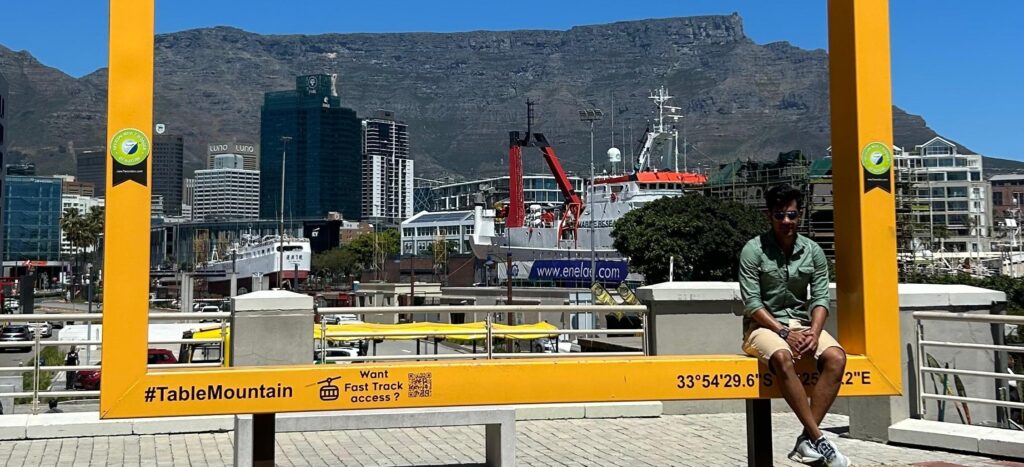
Alongside his research, Raktim also took time to explore the region. He discovered the local surroundings – becoming a particular fan of the Blue Bird Garage – and joined Dr. David on trips to Langebaan and Paternoster. Like any visitor to Cape Town, he also made his way to one of the city’s landmarks: Table Mountain.
“I first met Dr Claire David online during my selection interview for the Baden-Württemberg Stipendium. From that moment on, I wanted to work with her! I found AIMS to be a very unique environment for the students to work in, staying and dining with the lecturers themselves. I hope I get the opportunity to work at AIMS again. This short-term project highly impacted my research experience, and Dr. David just pushed me to perfection. I also got acquainted with Prof. Harrison Prosper, who was not only supportive during the project but also very inspiring. I’m excited to see where this project leads to!”
Raktim returned to Heidelberg in mid-December, where he will begin his Master’s thesis on another detector at the Large Hadron Collider: ALICE.
“It was a real pleasure to work with Raktim,” says Dr David. “He is sharp, dedicated, and asks precisely the right questions. He was producing new results almost every day. I am especially glad that he had the opportunity to train machine-learning models on real experimental data and to become familiar with the conceptual and technical challenges of high-energy physics—excellent preparation for the start of his research career.”
The project is expected to continue on a part-time basis, with the goal of producing a preprint for submission to arXiv in 2026.
 English