
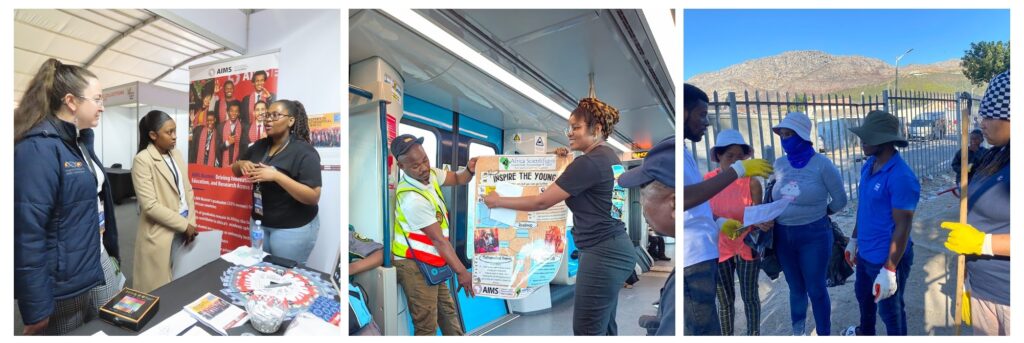
In 2025, the AIMS South Africa House of Science concluded the year by showcasing how mathematical sciences can be brought directly into communities. Master’s students from AIMS South Africa (Mastercard Foundation Scholars, Google DeepMind Scholars and SA-National Skills Fund Scholars cohorts) and Honours students from the University of Zululand (UNIZULU) engaged public audiences in Muizenberg and Empangeni, KwaZulu-Natal, as part of the Africa Scientifique: Leadership, Knowledge & Skills for Science Communication three-phased programme delivered in partnership with African Gong.
The students designed and delivered public engagement projects that translated abstract mathematical concepts into practical, accessible and empowering knowledge. These activities were part of Phase 3 of the Africa Scientifique Programme, which spanned six months of facilitated mentoring and science outreach support. During this phase, students applied the science communication and leadership skills gained at the intensive three-day Africa Scientifique Workshop held at AIMS South Africa in Muizenberg.
Mathematical Sciences in Service of Society
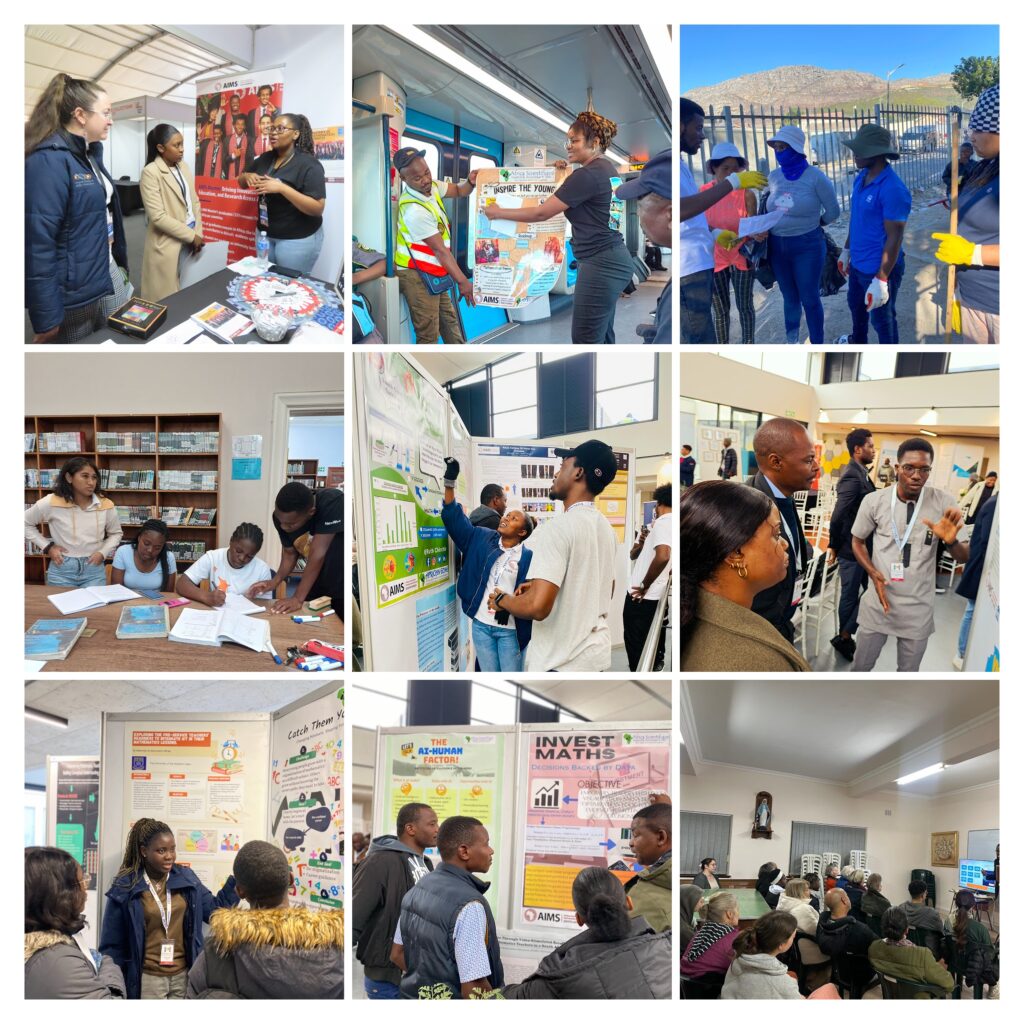
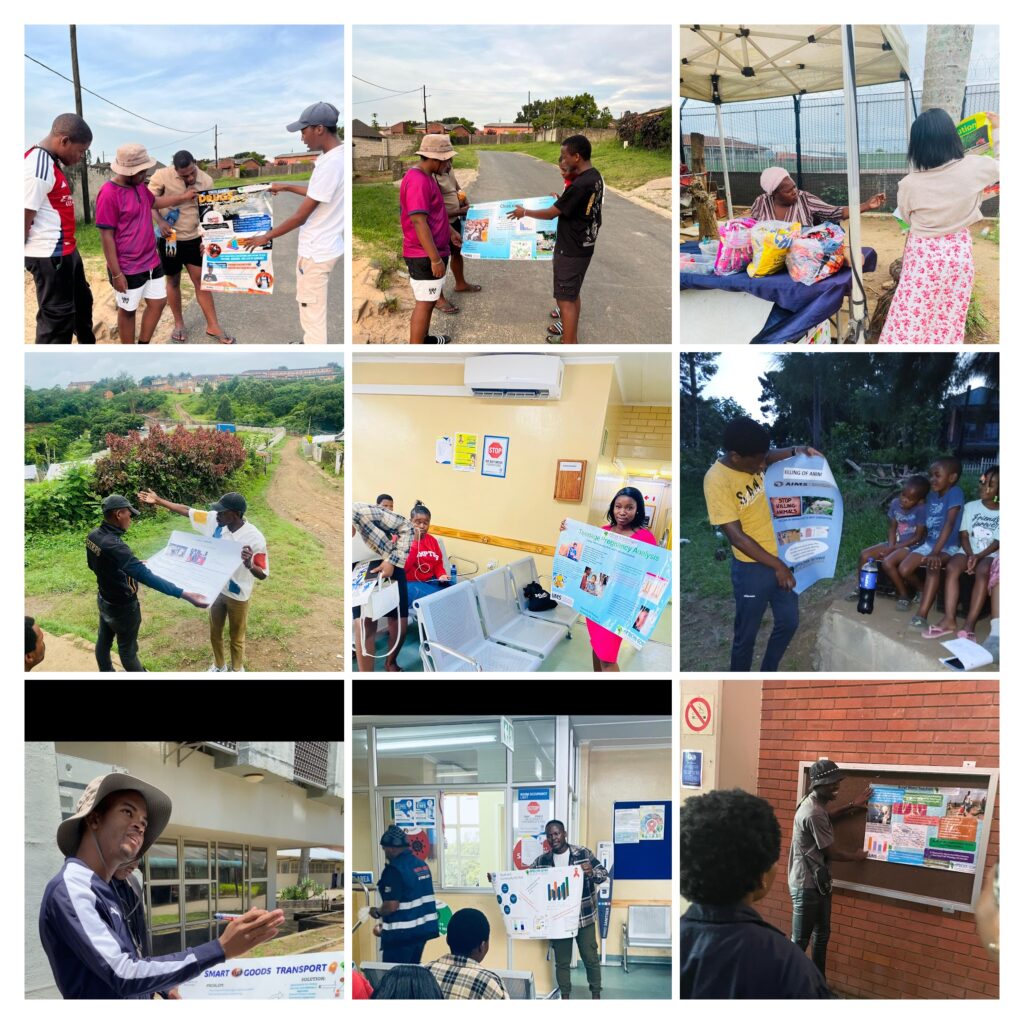
The student-led projects demonstrated how mathematical sciences can contribute to addressing real societal challenges, from education and youth development to agriculture, unemployment, climate change, transportation, health and waste management. By engaging hard-to-reach and often-neglected audiences, the students demonstrated that mathematical sciences can be a powerful tool for raising awareness, advancing empowerment and driving social change.
Science communication and public engagement projects were delivered across diverse settings and platforms, utilising visual tools, storytelling, and African indigenous languages to make science accessible and culturally relevant. Together, they highlighted students’ creativity, innovation, leadership, and commitment to serving society.
Learn by Doing: Science Communication Project Spotlights
Recognising Excellence and Leadership
All students who successfully completed their Phase 3 projects received a Leadership Award Certificate and a Commendation Letter in recognition of their growth in science communication, leadership and public engagement. AIMS students were recognised during the 2025 Recognition of Achievement Ceremonies, while UNIZULU students were honoured during a special online award ceremony with the UNIZULU Department of Mathematical Sciences.
The 2025 AS Institutional Leadership Award was given to Dr Phumlani Zondi, a Mathematics Lecturer at UNIZULU and an alumnus of AIMS, for his support of project planning and delivery for UNIZULU students in partnership with the House of Science and African Gong.
Student Reflections
| “The Africa Scientifique workshop taught me the importance of storytelling in science communication. It was a game-changer for me, highlighting the power of storytelling in science communication. I learned to own my expertise and communicate my research with confidence. It all comes down to effectively sharing my science with others. The post-workshop mentoring phase over the past six months has been super helpful in shaping my project and getting my messaging clear. The regular check-ins really helped me polish my poster, making sure its both scientifically solid and easy to understand” Nosimilo Mvelase – UNIZULU Hons Student |
| “Sharing my science communication project activity has awakened and instilled in me the need to be a symbol of hope in my community. I am a mathematical science graduate and through this project I have been able to identify research topics that I can use to better the lives of not only my community but the world at large. I am looking forward to deepening my mathematics knowledge, applying it to most pressing challenges and communicating it using tools I learned while doing this project.” Morongwa Ralefeta – AIMS South Africa Master’s Student |
| “Sharing my science communication project transformed me for the better because I learnt to work while I am out of my comfort zone, because as mathematicians we do not get to communicate with the community it is always solving long equations without communicating to anyone, and I had a lot of pressure doing this project because I also had my own school work to and also my research project, so I learnt to work under pressure. Not to mention the part of public engagement, at first I had no idea how I am going to engage with the community, but as time went by I was able to gain enough confidence to talk to the people” Mpilwenhle Khubone – UNIZULU Hons Student |
| “Attending the Africa Scientifique masterclass is one of the best personal decisions I ever made during my stay at AIMS South africa… In the beginning I was like this is just protocol but by end of the three days I was amazingly delighted by the soft skills I gained, amount which, the most valuable in my sense is the ability to clearly communicate ones ideas, capture the audience attention and deliver succinctly the message making the public engaged and involved in the message you are delivering. This skill now guides every piece of my scientific outreach. Presenting my project at a high-profile event sharpened my ability to communicate complex ideas succinctly and visually. The positive reception has strengthened my confidence in leading science-communication initiatives and forging international collaborations.” Koffi Benjamin AGBEGNAGLO – AIMS South Africa Master’s Student |
Looking Ahead to 2026
Science communication is increasingly recognised as essential for inclusive development and public trust in science. At AIMS South Africa, the Africa Scientifique Programme ensures that African graduates are equipped not only with strong technical expertise but also with the transferable skills necessary to communicate, lead, and drive developmental impact across Africa.Building on the success of the 2025 programme, delivered to both AIMS Master’s students and UNIZULU cohorts, AIMS South Africa will deliver the 2026 Africa Scientifique Programme to a new cohort of AIMS South Africa Master’s students, as well as Honours and Master’s students from Sol Plaatje University (SPU), the University of Fort Hare (UFH), and the Cape Peninsula University of Technology (CPUT) continue to build Africa’s capacity for science communication impact.
 English